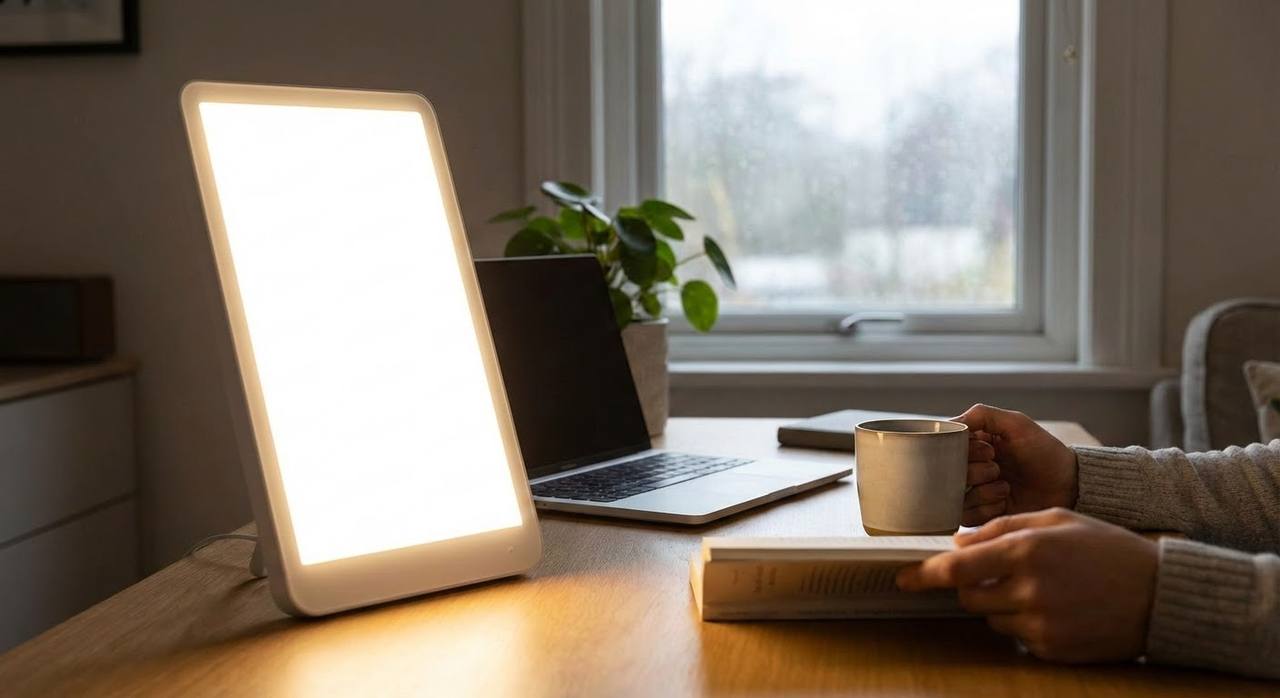
For many, winter is a sluggish descent into brain fog, low energy, and a dampened spirit. You’ve likely tried the standard fix: buying a Seasonal Affective Disorder (SAD) lamp. Yet, for most, that plastic box eventually becomes an expensive paperweight—dismissed as “ineffective” or simply too harsh to use.
The reality is that SAD isn’t just “winter blues”; it is a failure of biological synchronization. Our modern indoor environments are biological voids. While a bright office typically measures a meager 500 lux, our internal body clocks require a signal of 2,000 to 10,000 lux to maintain mood and energy. To reclaim your vitality, you need precision, not just brightness. This guide distills the clinical secrets to making light therapy actually work.
1. The “Inverse Square Law” is Your Lamp’s Biggest Enemy
The most common reason light therapy fails is distance. Light intensity does not drop off linearly; it follows the Inverse Square Law, meaning that doubling your distance from the lamp reduces its power by 75%.
If you sit “conveniently” far away, you are likely receiving a sub-therapeutic dose. As experts at The Sterling Institute warn:
“If you place the SAD lamp conveniently four feet away at a 60 degree angle you’ll need to use it for four hours to get the effect… There aren’t enough hours in the day to get anything out of the kind you hang on your wall.”
Pro-tip: Distance is lamp-dependent. A compact lamp may require you to be within 4 inches to reach 10,000 lux, whereas a high-powered panel can deliver that same dose from 30 inches away. Always check your manual for the specific 10,000-lux distance.
2. Light Therapy is a Clinical Heavyweight—Not Just for “The Blues”
Light therapy is often treated as a “wellness” supplement, but it is a primary clinical intervention. A landmark study published in JAMA Psychiatry found that 10,000-lux bright light therapy was remarkably effective for adults with non-seasonal Major Depressive Disorder (MDD), even outperforming standard antidepressants in some metrics.
The researchers concluded:
“The combination [of light and fluoxetine] and light monotherapy were significantly superior to placebo… but fluoxetine monotherapy was not superior to placebo.”
For many patients, light therapy wasn’t just an “add-on”—it was more effective than medication alone.
3. “Lux” is a Legacy Metric—Look for CLA and Glare
Most people shop for “10,000 Lux,” but Lux only measures visual brightness for the human eye. To fix your mood, you need Circadian Light (CLA), a metric weighted toward the blue-green wavelengths that trigger our biological clocks. Two lamps can have identical Lux, but the one with higher CLA will be far more effective at “waking up” your brain.
However, the reason most lamps collect dust isn’t a lack of CLA—it’s Glare (Lux per square inch).
- High Glare: A tiny, ultra-bright lamp is like a flashlight in a dark room—it’s uncomfortable and “stinging” to the eyes.
- Low Glare: A larger panel spreads the photons across a wider surface area.
A larger surface area (ideally at least one square foot) allows you to absorb the therapeutic dose comfortably without the “harsh” sensation that leads to non-compliance.
4. Geometry Matters: The 30-Degree “Sweet Spot”
Physical setup is where most users struggle. While max intensity is achieved by facing the lamp directly, this often causes uncomfortable glare. Clinical experts suggest a “Comfort Hack”: position the lamp at a 30-degree angle from your line of sight.
This angle allows the light to hit the peripheral retina—which is highly sensitive to circadian signals—without forcing you to stare into the sun.
The Golden Rules of Placement:
- Check the Manual: Identify your lamp’s specific 10,000-lux distance (from 4 to 24+ inches).
- The 30-Degree Offset: Place the lamp slightly to the side to hit the peripheral retina and reduce glare.
- Eye Level or Above: Mimic the sun. Light should shine downward toward your eyes, not up from the floor.
- No Staring: Keep your eyes open, but look down at a book or keyboard; indirect exposure is the biological trigger.
5. The “Dawn Simulation” Loophole
If 10,000-lux lamps feel too brutal for your morning routine, recent research suggests a gentler “loophole”: the sunrise alarm. While a SAD lamp is a 30-minute high-intensity blast, a sunrise alarm simulates a natural dawn over a 90-minute window while you are still asleep.
Research from Interior Medicine indicates that this gradual simulation can be “just as good” as a high-intensity lamp for some users. Because our eyes are ultra-sensitive to dim light even when closed, the faint, warm colors of a simulated sunrise trigger a natural morning cortisol rise, making the awakening process significantly less jarring.
6. More is Not Better: The Risks of Overuse
It is a dangerous misconception that sitting in front of a lamp all day provides extra benefits. Overuse can cause “circadian disruption,” confusing your body clock and triggering insomnia if used late in the day.
Furthermore, data shows that exceeding recommended doses leads to significant physical strain:
- Nausea: Reported by 15.9% of users.
- Jitteriness: Reported by 8.8% of users.
- Headaches: Reported by 8.4% of users.
To stay safe, limit your dose to 20–60 minutes in the early morning, preferably before 8:00 AM, and avoid evening use entirely.
Reclaiming Your Biological Clock
Light therapy is a potent, drug-free treatment, but it requires precision to bridge the “biological void” of modern life. By treating light as a timed, geometric “dose”—balancing CLA with low-glare comfort—you can effectively reset your internal clock.
As the days grow shorter, ask yourself: How will you adjust your environment to invite the “sun” back in this morning?
Leave a Reply